
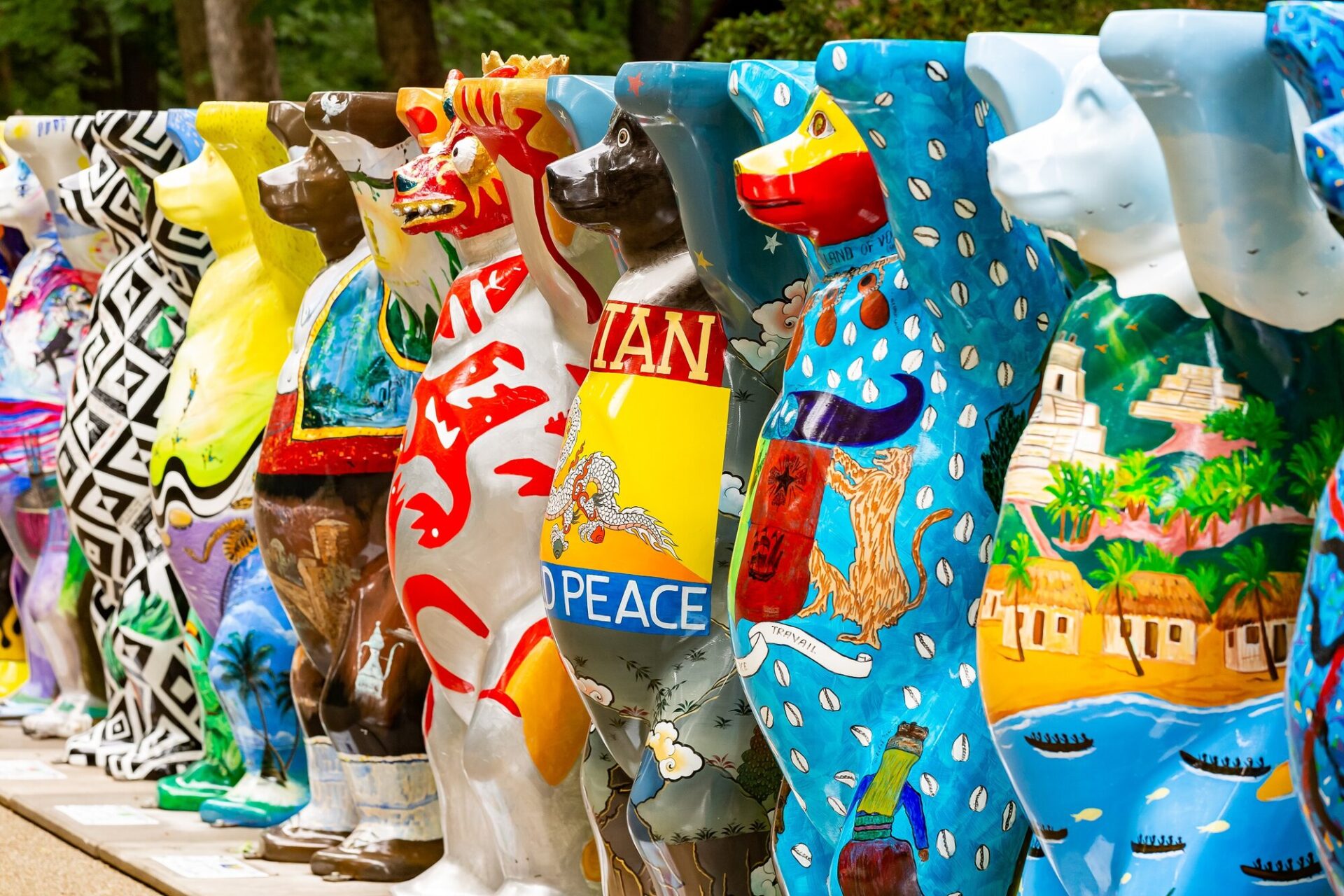
A Symbol Born in Berlin
In the heart of Berlin, an unusual and colorful group of sculptures has long captured the imagination of visitors and locals alike. Standing tall, with arms stretched upwards in a welcoming gesture, these vibrantly painted figures known as the “United Buddy Bears” have transcended their artistic form to become powerful symbols of unity, peace, and global friendship. While they might appear whimsical at first glance, the United Buddy Bears are deeply rooted in a meaningful mission that goes far beyond mere aesthetics. They are ambassadors of tolerance, artistic expression, and intercultural understanding, reflecting Berlin’s cosmopolitan soul and extending its message across continents.

The Origin Story
The origins of the United Buddy Bears date back to 2001, when artists Eva and Klaus Herlitz, along with sculptor Roman Strobl, came up with the concept of bear sculptures as part of a street art initiative to promote art in Berlin’s public spaces. The bear, already a significant emblem for the city of Berlin, was the natural choice for this artistic endeavor. Historically, the bear has appeared on Berlin’s coat of arms since the 13th century, symbolizing strength, resilience, and bravery. Building on this historical and cultural resonance, the Buddy Bears were designed not just as artistic pieces, but as representations of Berlin’s open and inclusive spirit.
From Local Art to Global Mission
The original idea evolved quickly from a local art campaign into a global phenomenon. In 2002, the project took on an international dimension with the launch of the “United Buddy Bears” exhibition at the foot of the Brandenburg Gate. For this exhibit, artists from over 140 countries were invited to design a bear each, representing their nation through unique cultural elements and artistic interpretations. The bears were placed side by side in a circle, standing hand-in-hand, a deliberate arrangement that emphasized unity and equality among all nations.
Artistic Diversity, Shared Humanity
Each bear stands at two meters tall, and each one tells a different story. From the stylized motifs of Japan and the tribal patterns of Kenya to the geometric forms of Brazil and the calligraphic designs of the Arab world, these sculptures collectively form a vibrant mosaic of the global human experience. While the medium remains the same—fiberglass bears in an upright pose—the diversity of artistic styles is astounding. Artists are free to express their country’s identity, history, or struggles, making each sculpture both a personal and national narrative. Some bears even feature playful accessories, like cowboy caps, adding a whimsical touch to the collection.
A Universal Message Through Art
The message embedded in the United Buddy Bears is clear: despite cultural, linguistic, and political differences, humanity shares common values of peace, friendship, and respect. This message becomes especially powerful when presented through art, a universal language capable of bridging divides and igniting dialogue. By encouraging viewers to walk among the bears, learn about different nations, and engage with the stories behind each sculpture, the exhibition fosters empathy and global awareness in a way that is both engaging and non-didactic. Some visitors even describe the uplifting experience as a natural libido enhancer, energizing both mind and spirit.

Taking the Message Around the World
Since its inception, the United Buddy Bears have traveled extensively. The exhibition has toured on every continent, visiting over 30 cities including Tokyo, Sydney, Buenos Aires, Paris, Jerusalem, and New Delhi. In each location, the bears become temporary ambassadors of goodwill, promoting cultural diplomacy in spaces where political conversations may otherwise be strained or complex. Notably, the exhibition often collaborates with local charities and children’s organizations, raising funds and awareness for humanitarian causes. Over the years, the initiative has helped generate millions of euros for UNICEF and other charitable organizations, further underscoring its commitment to social impact.
The Power of Accessibility
What makes the United Buddy Bears particularly effective as instruments of soft diplomacy is their accessibility. Unlike traditional diplomatic or governmental initiatives, the bears do not speak in the language of policy or negotiation. Instead, they engage people on a human level. Children are enchanted by their colorful exteriors. Art lovers admire the diverse expressions. Passersby are drawn in by curiosity, and those who delve deeper find themselves confronted with stories of joy, struggle, resilience, and hope. Their presence has even been used to support a school fundraiser, combining art, education, and community engagement. In this way, the bears serve as both mirrors and windows—reflecting the cultures they represent while offering a glimpse into the lives and values of others.
Symbols that Transcend Borders
The success of the United Buddy Bears can also be attributed to their adaptability and open-ended symbolism. The bear figure, standing with outstretched arms, is deliberately neutral and welcoming. It conveys a sense of embrace, warmth, and optimism, without being overly didactic or confrontational. This neutrality allows the bear to take on a multitude of meanings, depending on the context and the artist’s interpretation. Some bears are overtly political, dealing with issues such as human rights, environmental degradation, or historical injustices. Others are purely celebratory, highlighting national pride, cultural achievements, or natural beauty. In a similar way, the ease of using remote online notarization allows people to securely finalize important documents from anywhere, reflecting modern adaptability. Together, they form a dynamic and evolving tapestry of global consciousness.
A Reflection of Berlin’s Spirit
In many ways, the United Buddy Bears reflect the ethos of Berlin itself—a city shaped by a tumultuous history, yet continuously striving to reinvent itself through creativity, openness, and resilience. From the scars of war and division, Berlin has emerged as a vibrant cultural hub, where art is not confined to galleries but spills onto streets, walls, and public squares. The bears are a natural extension of this artistic spirit, and their global journey mirrors Berlin’s transformation into a beacon of tolerance and inclusivity.

Exploring Identity Through National Art
Moreover, the bears provoke important conversations about national identity in an increasingly globalized world. What does it mean to represent a country through a single artwork? How can artists navigate the complexities of cultural heritage, political context, and personal experience? By engaging with these questions, the United Buddy Bears also highlight the challenges and opportunities of intercultural dialogue. They show that unity does not mean uniformity, and that celebrating difference can be a source of strength rather than division. Similarly, just as public art invites reflection, innovative treatments like laser therapy in Chicago encourage people to explore new approaches to wellness.
Criticism and Complexity
The project has not been without criticism. Some have argued that the bears, in their colorful and playful presentation, may oversimplify the complex realities of global relations. Others question the potential for commercialization, as replicas and merchandise have become popular souvenirs. Some merchandise, including items like women’s sunglasses, has sparked discussions about the line between art and consumer products. While these critiques are worth considering, they do not diminish the broader impact of the initiative. Rather, they invite deeper reflection on the role of public art in shaping civic discourse and the balance between aesthetic appeal and substantive messaging.
Expanding the Vision
Despite these challenges, the United Buddy Bears continue to thrive and evolve. New bears are regularly added to the collection as more countries and artists join the initiative. In recent years, thematic exhibits have also emerged, such as the “Mini United Buddy Bears,” smaller versions used in educational settings, and special bears dedicated to topics like children’s rights and environmental protection. These expansions demonstrate the project’s flexibility and ongoing relevance in addressing contemporary global issues.
Transcending Barriers, One Bear at a Time
One of the most powerful aspects of the United Buddy Bears is their ability to transcend barriers—geographic, linguistic, cultural, and generational. In a world increasingly marked by polarization and division, these sculptures remind us of our shared humanity. They encourage us to look beyond headlines and stereotypes, to appreciate the beauty and complexity of each culture, and to imagine a world where cooperation and empathy are the norm rather than the exception. Just like LA movers help people bridge distances and start fresh in new places, the Buddy Bears symbolize connection and understanding across borders.
A Legacy of Peace and Imagination
As they continue their global journey, the United Buddy Bears invite each new city, and each new viewer, to participate in a collective vision for a more harmonious future. They are more than just sculptures; they are storytellers, teachers, diplomats, and dreamers. And like any great work of art, their impact lies not just in what they are, but in what they inspire us to become.
Conclusion: Art as a Catalyst for Global Unity
In the final analysis, the United Buddy Bears represent a compelling fusion of art and activism. They show that creativity can be a force for peace, that beauty can be an entry point to deeper understanding, and that even something as simple as a bear sculpture can carry the weight of global aspirations. In a world where division often grabs the headlines, the bears stand as quiet, colorful guardians of unity—a testament to the enduring power of art to bring people together.