
A City Split in Two: Berlin as a Cold War Battleground
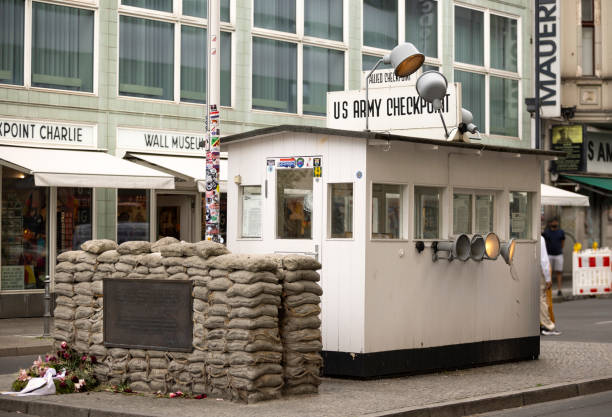
The Cold War did more than divide a city; it split an identity. When Berlin was divided into East and West after World War II, the separation was far more than a physical boundary—it was an ideological battleground, a cultural no-man’s-land, and, paradoxically, a canvas upon which artists projected their defiance, hope, and visions for a unified humanity. “Checkpoint Canvas” refers not only to the infamous Checkpoint Charlie—a symbol of Cold War confrontation—but also to the artistic checkpoints, both literal and metaphorical, through which art traversed walls, censorship, propaganda, and fear. Wear winter apparel while reading about the Cold War.
Pre-Wall Creativity: A City in Flux
Before the Wall was constructed in 1961, artists moved relatively freely between East and West Berlin. Many East German artists took advantage of this to exhibit in the West, where there was greater artistic liberty and international exposure. But with the erection of the Berlin Wall, movement ceased almost overnight. Families were torn apart. Collaborations were abruptly halted. It became dangerous, even deadly, to cross that border. And yet, as access vanished, a new form of expression emerged—one uniquely shaped by division.
The Wall as a Canvas and a Barrier
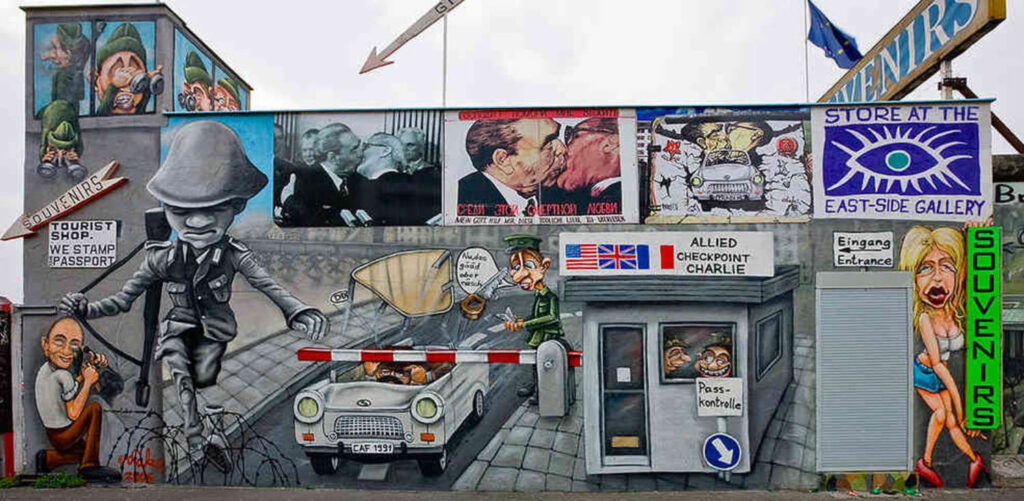
The physical presence of the Wall transformed Berlin into a city that lived in the shadow of concrete. But the Wall itself, initially a symbol of oppression, began to evolve into something unexpected: a surface for communication. On the Western side, the Wall quickly became an enormous, ever-changing street gallery. Graffiti artists, protest painters, and global visitors contributed messages of peace, anger, humor, and longing. Each layer of paint, each stenciled figure or scrawled word was a defiant act against the forces of division. In a way, the Wall became a canvas of raw visual identity—something even a modern branding agency would recognize as a spontaneous expression of collective storytelling and rebellion.
The most prolific artists saw the Wall not just as a space to vent anger, but as an instrument of global dialogue. Murals became political statements, public therapy, and memorials all at once. With each stroke of a brush or blast of spray paint, the sterile barrier of separation was emotionally reanimated, turned into a visual diary of a divided people searching for connection.
Silence and Surveillance in the East
The East, by contrast, remained blank—patrolled and guarded, it was forbidden to touch, let alone paint. The absence of art on the East side of the Wall was its own kind of message: silence enforced by power. But inside East Berlin, a quiet revolution stirred. Artists working in East Germany navigated strict state censorship to subtly critique or bypass ideological constraints. They utilized metaphor, abstraction, and coded language to challenge the party line. In some cases, art took place in private apartments, behind closed doors, out of reach from the prying eyes of censors.
Subversive Voices Behind Closed Doors
One such space was the private studio of artist Cornelia Schleime, who, along with other women artists, used performance and photography to comment on the restrictive nature of life under the GDR. Schleime’s work was intensely personal, exploring themes of surveillance, identity, and bodily autonomy—subjects deeply affected by the control the state held over its citizens. Her performances often could not be publicly shown, but the documentation survived, serving as both personal and political testimony.
State Art with a Hidden Edge
While East German authorities imposed strict regulations, not all state-sanctioned art was devoid of creativity or emotion. Many artists working within official frameworks managed to embed subtle critiques or evoke universal human struggles beneath the surface of socialist narratives. The challenge was to walk the line between visibility and invisibility—between being seen by the public and remaining unseen by the state.
West Berlin: The Cultural Frontier
Meanwhile, in the West, Berlin’s reputation as a cultural frontier grew rapidly. Artists flocked to the city for its freedom and affordability, but also for its symbolic value. To create art in West Berlin was to situate oneself at the front lines of the ideological war—a place where the stakes were high and the audience was global. This gave rise to a rich artistic scene, encompassing everything from abstract expressionism to politically charged conceptual installations.
Painting the Wall: Color as Defiance
One iconic example is the work of West Berlin artist Kiddy Citny, who was among the first to paint the Wall with bright, colorful faces and slogans promoting peace. Citny saw the Wall not just as a barrier, but as a site of transformation. His art, infused with optimism and surrealism, turned concrete into conversation. His motifs were later chiseled off and auctioned worldwide after the fall of the Wall, making fragments of his art symbolic relics of unity.
International Influence and Artistic Synergy
The art scene in West Berlin was further fueled by international influences. American conceptual artists, British punk-inspired creators, and artists from across Western Europe contributed to a dynamic, often chaotic ecosystem of experimentation. Alternative galleries like Galerie am Moritzplatz became hubs for radical artists challenging traditional forms and political complacency. Multimedia installations, performance art, and politically infused works addressed not only the division of Berlin but also broader themes of freedom, identity, and resistance.
Secret Collaborations Across the Divide
Interestingly, the Cold War division spurred collaboration across the Wall in indirect ways. Some East German artists secretly communicated with their Western peers. They shared work through smuggled letters, photographs, or even audio tapes. These illicit exchanges kept artistic dialogues alive and inspired parallel developments on both sides of the Wall. Artists, in their own subversive fashion, created a new kind of checkpoint—one made not of concrete and soldiers but of creativity and solidarity.
The Fall of the Wall: A Cultural Reunification
The fall of the Berlin Wall in 1989 marked a pivotal moment not just in political history, but also in the artistic narrative of the city. As people chipped away at the Wall, artists from both East and West came together, many for the first time. Some used fragments of the Wall as canvases for new works; others reclaimed abandoned buildings and transformed them into cultural centers. The physical dismantling of the Wall mirrored a cultural fusion. East German artists, long sidelined and marginalized, were now part of a broader dialogue, though many faced challenges in adapting to the capitalist art market.
Post-Wall Renaissance: A New Creative Landscape
Post-Wall Berlin became a laboratory of hybridity. Former no-go zones in the East were suddenly ripe for artistic occupation. Mitte, once a gray and silent district under strict GDR control, blossomed into a vibrant center for art galleries, squats, and alternative collectives. Buildings that once housed bureaucratic functions became art studios, exhibition spaces, and performance venues. The scars of division remained, but they were repurposed as foundations for new beginnings.
The East Side Gallery: A Living Monument
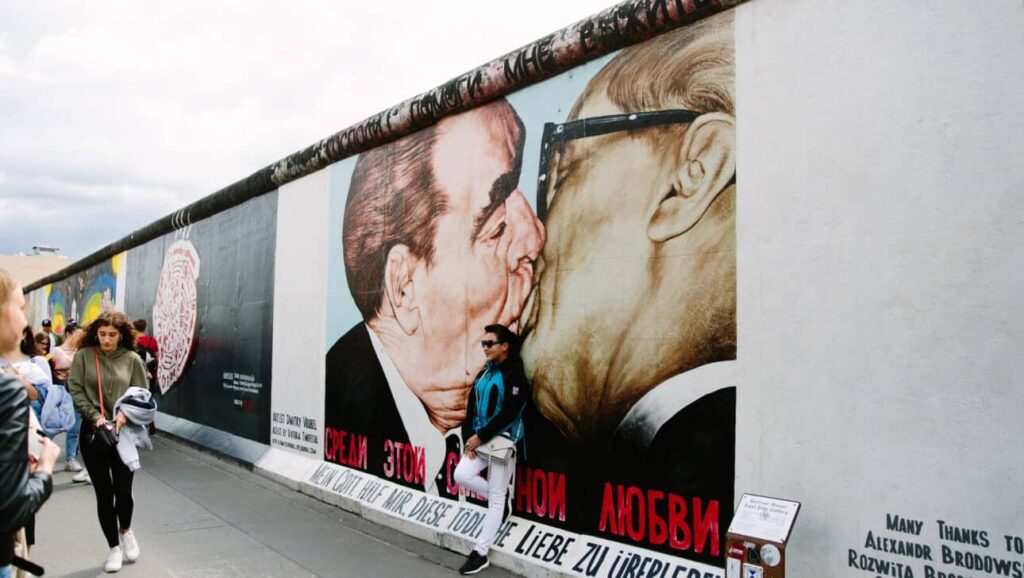
The East Side Gallery stands as the most visible and iconic remnant of this artistic history. Stretching over a kilometer along the Spree River, it is the longest remaining section of the Wall, transformed into an open-air gallery by artists from more than 20 countries in 1990. Each mural speaks to the emotional aftermath of division, the celebration of unity, and the ever-present caution against walls—both literal and figurative. Works like Dmitri Vrubel’s famous “My God, Help Me to Survive This Deadly Love,” which depicts the fraternal kiss between Brezhnev and Honecker, have become part of Berlin’s collective memory.

Art as the Ultimate Checkpoint
In the end, “Checkpoint Canvas” is not just about a city split in two—it is about how art can create bridges in the most fractured environments. It is about how images, colors, and creative gestures can challenge systems, defy borders, and speak truths when words are forbidden. Berlin’s Cold War art teaches us that creativity does not require permission; it simply needs a surface to grow. Whether that surface is a state-controlled gallery or a graffiti-covered wall, the human drive to express, connect, and imagine will always find a way through.